
Brentwood City Directory Holdings
For historical directory work, the confirmed first stop is Williamson County Public Library Special Collections in Franklin. Its official description includes city directories, yearbooks, newspapers, local histories, tax records, historic court material, and genealogy resources. It confirms the collection category, but does not publish a title-by-title directory shelf list, publisher names, years, an address-order run, or scanned Brentwood volumes. That gap matters. Ask staff for the city, county, or nearby-city heading that fits the person and period instead of assuming that a volume exists or that it uses one standard format.
| Collection or source | Confirmed coverage | Where held | Access route |
|---|---|---|---|
| WCPL Special Collections city directories | Exact years and publishers are not posted | 1314 Columbia Avenue, Franklin | In-room use; ask staff for title, year, and format |
| WCPL newspapers, wills, WPA, and court microfilm | Item-level years are not posted | WCPL Special Collections | In-person research with a confirmed person or address |
| Williamson County Archives marriage index | 1803–1987 | Online index and Franklin reading room | Use a name reference, then inspect the cited location |
| Williamson County Archives deed index | 1786; 1792–1963; and 1977 | Online index and Franklin reading room | Grantor/grantee and book/page lead for property work |
| Archives obituary and death notices | Stated ranges include 1822–2026 | Online index and Franklin reading room | Notice or reference lead, not a household directory |
The useful request is specific: give staff “Brentwood,” “Williamson County,” or a nearby heading, the surname or address, and the decades needed. Then ask whether the item is alphabetical, a telephone book, a school yearbook, a newspaper index, or an address-order volume. That protects against reading a collection label as a promise of uninterrupted annual coverage.
Note: A missing library year is a collection gap, not proof that a household was absent from Williamson County.
Brentwood City Directory Room Visit
Special Collections is a physical research room, not a lending shelf. Its older and rare materials are noncirculating, so use takes place in the room. The library lists hours as closed Sunday and Monday; Tuesday, Wednesday, Friday, and Saturday from 9:30 a.m. to 5:30 p.m.; and Thursday from noon to 8 p.m. The room telephone is (615) 595-1246. A visitor from outside the area can ask the Circulation Desk for a computer guest pass, use wi-fi, and consult in-library genealogy databases, including Ancestry.
Before traveling, call with the surname, alternate spellings, address, and time period. Ask whether a particular city directory, yearbook, or newspaper is available that day and whether an address-order or reverse format exists for that year. Library staff can also direct a search toward local history databases, which the WCPL database list identifies as covering Williamson County genealogy, African-American genealogy, newspaper articles, obituaries, and related history.
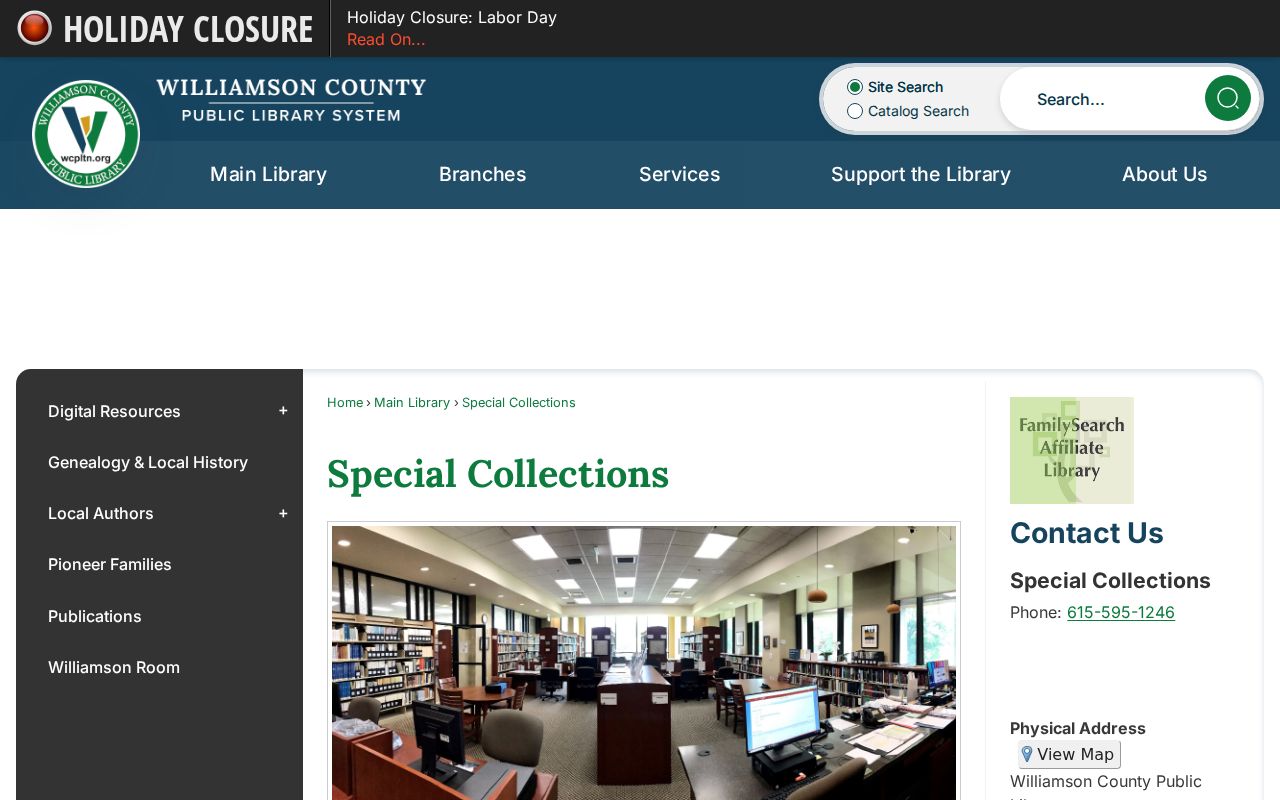
The library screen supports a visit-and-verify approach. It does not show a particular Brentwood directory entry, so the actual volume, its year, and its abbreviations still need to be checked in the room.
Reading a Brentwood City Directory
A real entry must control the transcription. No official local digitized Brentwood entry was found during the research, so no field should be assumed for every volume. Once staff produces a confirmed volume, photograph or transcribe the title page and abbreviation key when collection rules allow. Then copy the entry exactly, including punctuation and shortened words. The following inventory is a capture protocol, not a claim that each field appears in a Williamson County directory.
| Volume identity | Record the printed title, year, publisher, and the section used. |
|---|---|
| Name line | Copy the head-of-household name exactly as printed; retain middle initials and alternate spellings. |
| Relationship clue | Capture a spouse or relationship notation only if the entry prints one. |
| Work notation | Copy an occupation or employer phrase only when it appears in that entry. |
| Address clue | Record the street address, cross street, ward, telephone clue, or owner/renter mark only when printed. |
| Abbreviations | Copy each abbreviation exactly and retain the volume’s own key beside the transcription. |
- Criss-cross directory
- An address-order or reverse directory that can be used to find names by street, but only if WCPL confirms that format for the requested year.
- Householder index
- A name arrangement for the household reference printed in a particular volume; check the volume rather than assuming it has one.
- Abbreviation key
- The publisher’s explanation of shortened words and marks, often near the front of the actual volume. Its meaning can change by year or publisher.
A city directory record is best read as a dated printed observation. It may support a name, place, or community connection, but an apparent address match needs support from records that identify the same person, period, or property.
Brentwood City Directories and Archives
The Williamson County Archives is the companion repository when a directory find needs a record trail. Its public index reports more than 405,000 descriptive entries, but an index result commonly points to a microfilm reel, bound book, or loose file in the Franklin reading room rather than a digital image. The Archives is at 611 W. Main Street, Franklin, with listed contact (615) 790-5462 and archives@williamsoncounty-tn.gov. Reading-room hours are Monday through Friday, 8 a.m. to 4:30 p.m., with seasonal Saturday hours from late April through October.
Its record groups can place a directory name in a broader county timeline. The online index lists marriages from 1803 to 1987, deeds from 1786, 1792–1963, and 1977, probate from 1801 to 2025, wills from 1800 to 1987, chancery from 1815 to 2018, circuit court from 1805 to 2004, and county court from 1800 to 1982. Those uneven ranges are reference paths, not a claim that a city directory exists for each year.
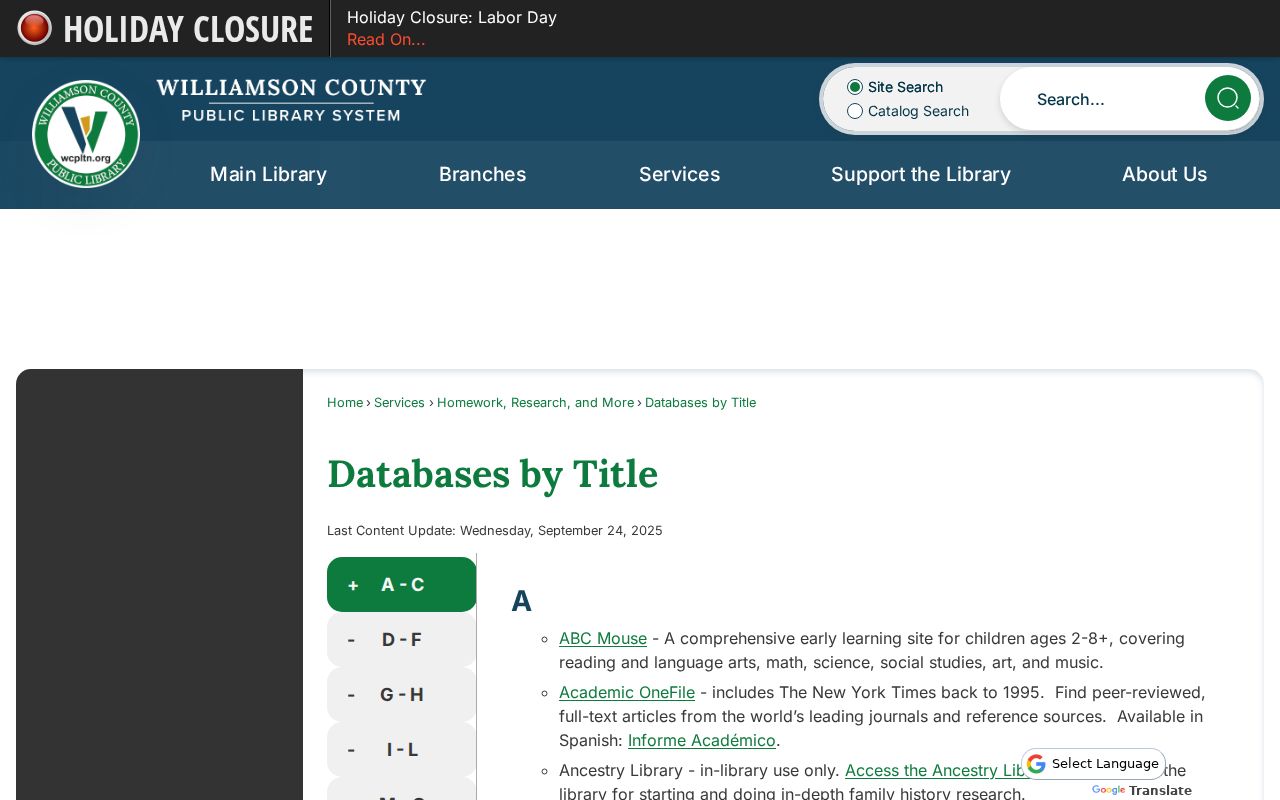
The database page helps identify the library’s genealogy and local-history resources. It does not replace checking the exact directory volume or the physical record cited by an Archives index result.
Tracing Brentwood City Directory Households
Trace a household only across volumes that staff has confirmed. Begin with the most useful known name or address, then compare adjacent available years rather than filling absent years with guesses. A city directory can bridge a period between census releases, but it cannot replace a census, deed, probate file, or obituary. Federal census releases follow the 72-year rule, while the library’s newspaper microfilm and the Archives obituary index can supply date-bounded confirmation.
- Ask WCPL for the exact available title, year, and section that fits the person or address.
- Transcribe the entry and its abbreviation key, preserving name form, address, and every printed relationship or work clue.
- Compare the next confirmed earlier or later volume for changes in spelling, spouse notation, address, or occupation.
- Pair a confirmed directory period with the appropriate released census, newspaper, marriage, deed, tax, probate, or obituary reference.
- When a name disappears, test a move, death, unlisted year, alternate spelling, or collection gap before drawing a conclusion.
A historical name can require more than a modern city label. A directory clue that needs a current-name check belongs in the Brentwood resident lookup workflow, where parcel, court, vital, and person-specific sources answer narrower questions.
Brentwood Names in Directory Searches
Historic research can sit under a place name other than Brentwood. City history places railroad-era lot sales in 1856, while modern municipal incorporation came in 1969. Earlier material may instead use Williamson County, Cottonport, Hardscuffle, Concord Road, Wilson Pike, Franklin, Nashville, or a road and legal-description reference. Search those terms as alternatives when an expected modern-city heading produces nothing.
- 1856: the city history describes railroad-era lot plans and sales for the village.
- 1969: Brentwood incorporated as a municipality, so older county material can precede its modern city label.
This is a records-geography issue, not a reason to rename a person or an address without evidence. Keep the original catalog wording beside the modern place term used for comparison.
Note: Cottonport and Hardscuffle are historical search terms, not confirmed modern postal neighborhood labels.
Thelma Battle in Brentwood Research
The county historic-home guide specifically names the Thelma Battle Collection in the Archives reading room as an African-American genealogy resource. It belongs beside, rather than inside, a city-directory search because directories and standard property trails can omit or abbreviate people and communities. The same guide points researchers toward local church, school, public-building, and cemetery deed binders, subject files, newspapers, naturalizations, delayed birth material, and other county records.
Use that collection through the Archives’ reading-room route and describe the actual item consulted. Local history books and library resources can supply context, while a deed, tax book, probate file, newspaper item, or other original record supplies the documented fact for a specific person or place.
Limits of Brentwood City Directories
City directories are not a master roster. Exact local directory years, publishers, scan availability, and reverse formats were not verified online, and the collections should not be represented as a continuous run. A property owner, a directory name, and a person at an address can be different facts. For a historic address, the Williamson County Archives and Register of Deeds can document a title trail, while a directory may add a dated household clue only where an actual volume supports it.
For records that are not available at a counter or in an index, Tennessee’s Public Records Act allows Tennessee citizens to seek sufficiently described existing public records from the proper custodian, subject to confidentiality and redaction. Neither the city nor county is required to create a new resident list. Respect protected information and use archival material for lawful personal, family-history, and local-history research.