
Brentwood Previous Residents by Record Era
Past residents of one Brentwood address leave several kinds of evidence. The current assessment record gives a present parcel and owner anchor. The Register of Deeds handles the later conveyance portion of the title trail. Earlier deeds move to the Williamson County Archives, where a public index supplies references to microfilm, books, or files in the reading room. Household sources help only after the parcel and time period are clear. The table separates confirmed local coverage from material that requires staff confirmation instead of inventing a continuous online record.
| Source | Confirmed era | Where held | What it can show |
|---|---|---|---|
| Current Assessor property search | Current system; no historic start year posted | Online county search | Present parcel, owner, lot, sale, and address clues. |
| Register of Deeds | Start after 1966 under the county guide | Franklin Register counter or phone route | Current and post-1966 instrument reference. |
| Archives deed index and microfilm | 1786, 1792–1963, and 1977 listed | Online index and Franklin reading room | Grantor, grantee, year, document, and book/page lead. |
| Archives probate and obituary groups | Probate 1801–2025; notices include 1822–2026 | Index and reading room | Estate, heir, death, and newspaper follow-up. |
| WCPL Special Collections | Exact directory and yearbook runs not posted | Franklin library research room | Staff-confirmed household, newspaper, and local-history sources. |
Use the era in question to choose the first custodian. The county guide gives a practical split, while the Archives index’s uneven deed years show why a single web search cannot stand in for every period.
Brentwood Previous Residents Start With a Parcel
Enter a current address in Williamson County Property Search and preserve the property address, owner or owners, parcel description, lot number, subdivision, map or parcel number, and available sale details. The property address is the situs address, meaning the physical parcel location. A mailing address is where tax notices go and may differ. Neither field proves that every person at an address lived there, but the parcel facts provide the stable bridge to title records.
That bridge matters more than a street number when a property has been replatted, a road appears under an older name, or a deed uses only lot and subdivision language. The current sale date is a useful lead, not a complete title chain. Open only a lawful public parcel detail or ask the Assessor for an address-specific clarification if the result needs interpretation. The county service is informational and prohibits bulk collection and redistribution.
Note: Write the parcel and legal-description clues beside the address before contacting a deeds or Archives custodian.
Brentwood Previous Residents Through Deeds
Title records trace owners more reliably than all past residents. For a known current parcel, give the Williamson County Register of Deeds the current owner, date range, and legal description, lot, map, or parcel clue. The research did not locate a verified official county web screen for current instruments, so the appropriate start is the Register’s counter or phone route, not an assumed online index. Record both parties and the recording reference from the located instrument.
- Use the assessed parcel and current owner to identify the deed or conveyance tied to the current transfer.
- Record the grantee, the buyer or recipient, and the grantor, the seller or transferor, plus the execution and recording information when shown.
- Search the prior grantor as a later grantee, carrying forward the same legal description, lot, or subdivision where possible.
- Compare each ownership change with tax, probate, court, or newspaper leads rather than treating a deed as a move date.
- Move to the Archives index and microfilm for the pre-1966 portion of the property chain.
- Grantor and grantee
- The grantor transfers an interest; the grantee receives it. Their roles reverse as a chain moves backward.
- Chain of title
- A sequence of documented property transfers tied by parties and the same land description.
- Legal description
- The lot, subdivision, metes, or other land wording in an instrument. It can outlast a modern street address.
Brentwood Previous Residents and the 1966 Fork
Williamson County’s historic-home guide gives the clearest local rule for moving backward: begin after 1966 with the Register of Deeds, then use Archives microfilm for deeds drafted before 1966. This is a custody and access split, not a promise that one office has every earlier document online. The Archives site lists deed coverage as 1786, 1792–1963, and 1977. Those uneven ranges are worth preserving because they tell a researcher when to ask an archivist for the exact reel, book, or reference.
The Archives deed browse displays grantor/grantee, year, document, and book/page columns. A row is a discovery reference. It does not establish the full substance of the deed or guarantee an online image. Bring the result reference to the Archives reading room, contact the staff about copies, or use the Register for the post-1966 link.
The Williamson County Archives deed index below illustrates the historic discovery layer. Its columns help keep the book/page reference tied to the correct party and year before a microfilm or record-book request.
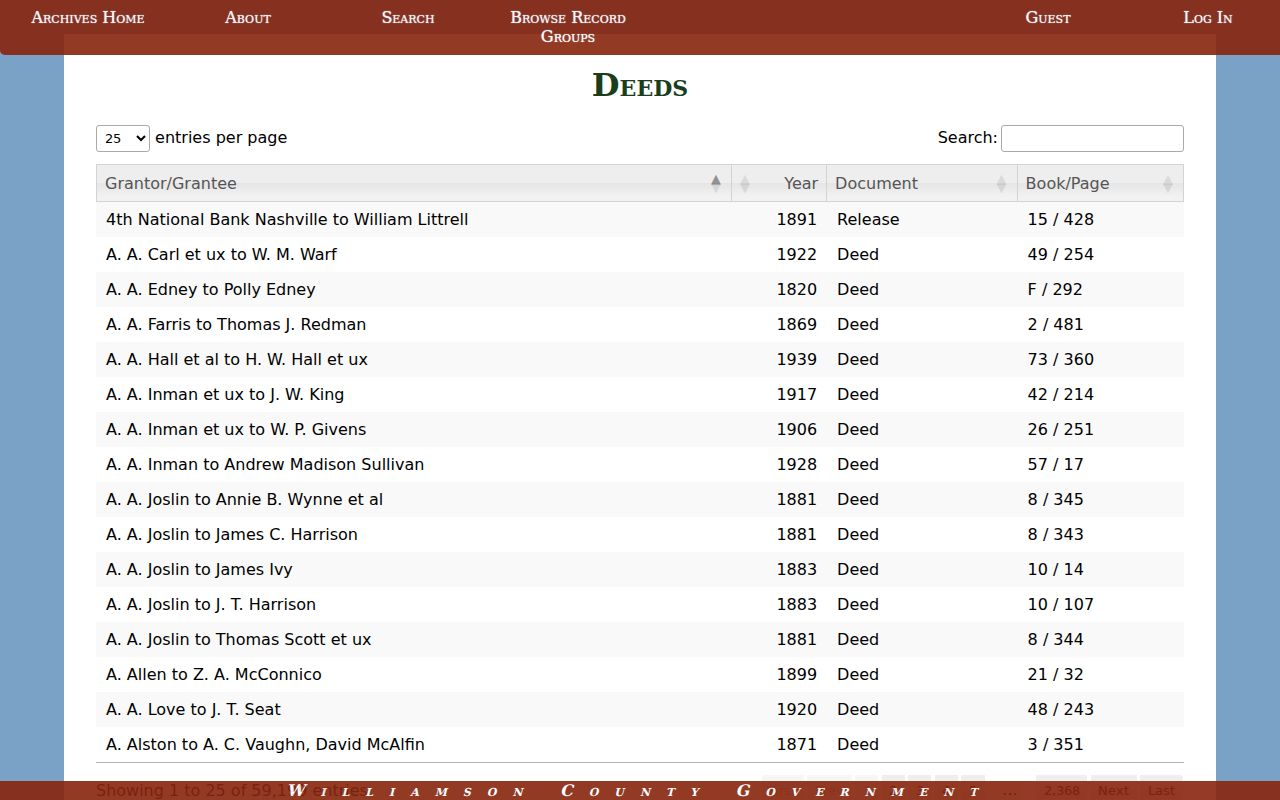
The image is a reminder to read an index as a route to the original record, rather than as a complete history of a person or property.
Brentwood Previous Residents: House and Land
The county historic-home guide makes an important distinction: a property trail is often easier to document than the history of a particular building or household. Private homes most often meet county records through deeds, tax books, and sometimes probate. That can establish land ownership without proving who slept in the building, when construction began, or whether a family remained after a conveyance. Treat the gap as a research result, not a reason to merge unrelated evidence.
After the land trail is solid, use the guide’s other local leads carefully. It names tax and probate books, historic-home survey material, local-history works, church, school, public-building, and cemetery deed binders, subject files, newspapers, delayed births, naturalizations, and the Thelma Battle Collection. Each can add context to a named family or place. None should replace a deed, parcel, or dated household source for a claim about past residence.
Brentwood Past Residents in Household Sources
Once a prior owner or date range is known, household evidence can test who lived here before. Williamson County Public Library Special Collections confirms city directories, school yearbooks, periodicals, newspapers, wills, WPA material, court records, and genealogy resources. It does not publish a verified Brentwood directory run, publisher list, or reverse-directory years online. Call ahead with the address, person, decade, and request for an alphabetical or reverse format. The collections themselves are described on the Brentwood city directory page.
Pair a staff-confirmed directory year with the appropriate federal census snapshot. Census access follows the 72-year release framework, so it provides periodic household evidence rather than a current list. Compare the printed address, spouse or relationship details when present, newspaper items, and the property trail. Absence from a directory is not proof of departure, since formats and coverage can differ.
- Set a date range from a deed transfer, tax clue, probate filing, or obituary reference.
- Ask WCPL whether it holds an applicable city directory, telephone directory, reverse volume, yearbook, or newspaper microfilm.
- Transcribe the actual printed title, year, name spelling, abbreviation key, and address from a consulted volume.
- Compare the household against the closest released census and an Archives death, probate, marriage, or obituary lead.
Brentwood Previous Residents Before 1969
Brentwood incorporated in 1969. Earlier records can be filed under Williamson County, Cottonport, Hardscuffle, Concord Road, Wilson Pike, Franklin, or a road or legal-description term. The City’s history also identifies railroad-era lot sales in 1856 and disruption of the original village area during the Interstate era. These are alternative geographic labels to search alongside a confirmed person, parcel, or date. They are not proof of a dated citywide renumbering or a replacement street number.
This geography explains why an address trail may cross institutions. A modern parcel begins with county assessment; later title work belongs at the Register; earlier deeds may be on Archives microfilm; and household context may sit at WCPL or the Archives. Search the historic name that appears in the actual source, then compare it with the legal description before treating it as the same location.
Brentwood Previous Residents at the Archives
The Williamson County Archives has more than 405,000 descriptive index entries and is a practical preparation point for an address history. It lists marriages from 1803–1987, probate from 1801–2025, wills from 1800–1987, county court from 1800–1982, circuit court from 1805–2004, chancery from 1815–2018, and obituary/death notices with ranges including 1822–2026. These years belong to separate record groups. A name hit needs the actual microfilm, bound book, or loose file checked before it is used as evidence.
The Archives record-group index gives the confirmed ranges and access route. It is useful to contact staff with a surname variant, record group, date span, parcel or deed book/page, and whether a reference is likely a microfilm, bound volume, or loose file. The reading room is at 611 W. Main Street in Franklin, with copy questions directed to the Archives.
The Archives index and its record-group coverage are pictured below. It is a bridge from a historic name or deed reference to the correct physical format, not a substitute for reading the underlying record.
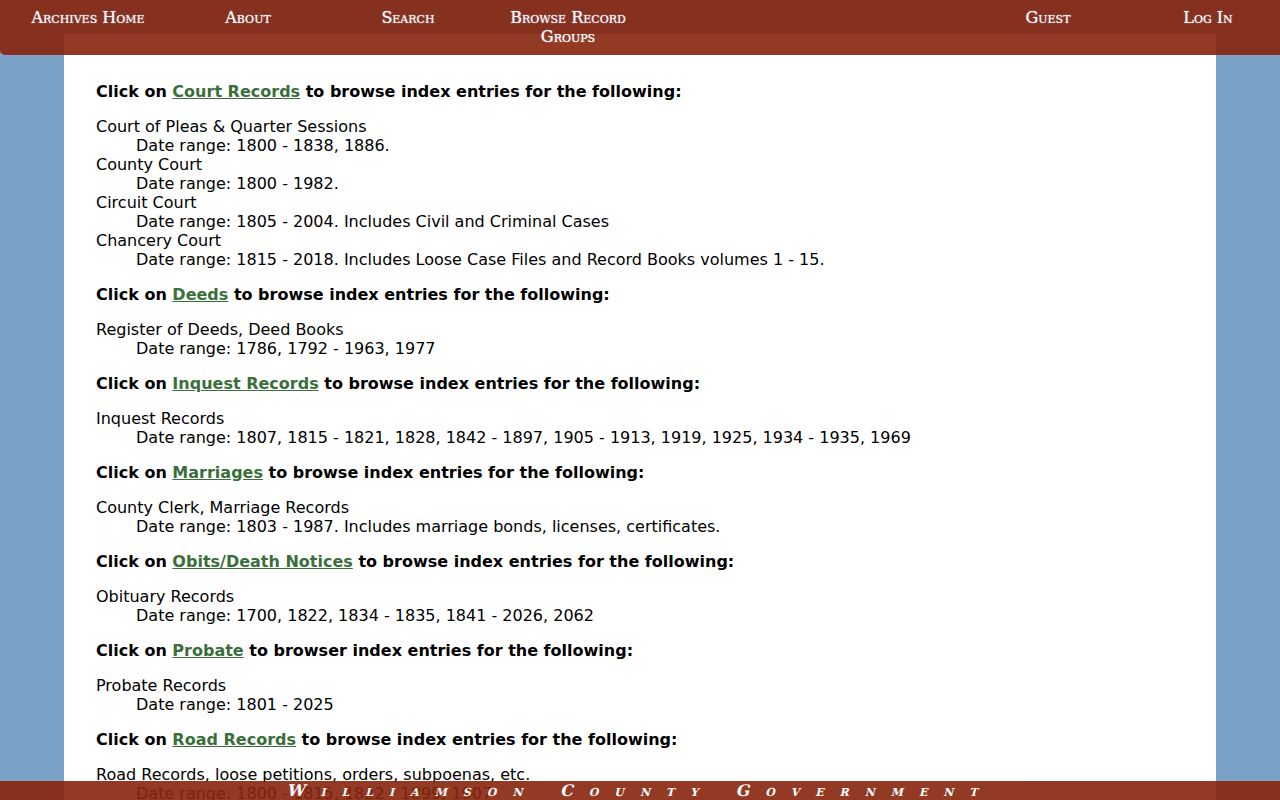
The local access split can save time: use the online index to prepare, then verify the cited material at the reading room or through the documented copy channel.
Note: An estate, obituary, or marriage index can supply a dated lead, but the underlying record determines the role and relationship it actually proves.